


Preparing a medical product for regulatory submission is about far more than completing the required documentation. It’s about having the right processes in place and knowing how to document them in a way that meets regulatory expectations. This is the key to a smooth submission. Regulatory guidance and standards serve as blueprints for human factors (HF) engineering and risk management processes, and most organizations invest significant time and expertise into developing the processes, documents, and evidence needed to demonstrate their products’ safety and effectiveness. Yet one question remains surprisingly difficult to answer, whether you are preparing your first submission or your hundredth:
Will your risk management and human factors documentation and processes stand up to regulatory review?
At Sage Research + Design, our core expertise is helping medical device companies answer that question. Our consultants have supported organizations developing operating room technologies, infusion systems, OTC wearable devices, SaMDs, diagnostics, digital health products, and many other medical technologies. Through risk management activities, usability studies, submission preparation, responses to regulatory questions, and ongoing interaction with evolving FDA and EU MDR expectations, we’ve developed something no individual manufacturer can easily acquire: a broad perspective on how regulatory expectations are interpreted across the industry. Every project builds on the last, allowing us to recognize patterns, common challenges, and emerging expectations that become visible only through repeated exposure across many companies and technologies. We pass on this expertise to each and every one of our clients that, in turn, leads to smoother and more successful regulatory submissions.
We’ve developed something no individual medical product team can easily acquire: a broad perspective on how regulatory expectations are interpreted across the industry.
Submission Uncertainty is Pervasive
In our over thirty years of experience, one of the most interesting things we’ve learned is that product teams’ confidence in their submission outcome does not necessarily correlate with experience developing medical products. We’ve worked with companies preparing their first submission, unsure where to begin, and with organizations that have successfully brought products to market for decades. Although these companies differ enormously in size, process maturity, and technology, they often reach the same point as submission approaches. They know their products exceptionally well. What they cannot know with the same certainty is how an independent reviewer will interpret the story their documentation tells.
That uncertainty exists because regulatory compliance is not simply about identifying the right standards and guidance documents. Human factors engineering is informed by FDA guidance documents and IEC 62366-1. Risk management is grounded in ISO 14971, together with device-specific standards where applicable. These guidance documents and standards establish the principles manufacturers should follow, but they intentionally leave room for professional judgement. This “gray area” is a dangerous zone of uncertainty. Although guidance documents and standards may offer examples and recommendations, they do not prescribe methods for exactly how documentation should be organized, how traceability should be demonstrated, or how much evidence or justification is needed in every situation. Those decisions depend on not only experience preparing regulatory submissions but also exposure to regulatory feedback that informs a deep understanding for how regulatory expectations continue to evolve.

As consultants who participate in a high volume of regulatory submissions each year, we have gained the specific expertise needed to help our clients reduce uncertainty and avoid common and costly submission pitfalls.
Why Submission Documentation Gaps Exist; Losing Sight of the Big Picture
Sometimes documentation gaps just happen through no fault of your own! Although documentation gaps can be the result of poor quality systems or inexperienced teams, they more often naturally emerge as organizations evolve. Templates are updated over time, responsibilities shift between departments, products become more sophisticated, and new regulatory guidance is incorporated into some processes before others. Individually, these changes make sense. Collectively, they can create subtle inconsistencies between risk management, human factors activities, design controls, and supporting documentation that no one notices because no single person has watched the entire system evolve.
Organizations preparing their first submission face a different challenge. Without previous regulatory experience, it can be difficult to distinguish between what standards explicitly require and what regulators have come to expect through years of interpretation and practice. Questions about risk file content, the adequacy of risk control measures, or the level of supporting evidence required rarely have simple answers. Sage’s experience and expertise help bridge that gap.
Perhaps the greatest challenge is that organizations rarely know whether these issues exist until someone outside the company identifies them. Internal teams review documentation with the benefit of knowing how it was created. Regulators see only the finished product. They rely entirely on the evidence presented. If important connections are unclear, terminology is inconsistent, or the rationale for key decisions is difficult to follow, reviewers are likely to ask questions that delay the submission process.
Organizations rarely know whether documentation gaps exist until someone outside the company identifies them. Ideally, these gaps are identified in a gap assessment prior to submission rather than by a regulatory reviewer.
The Cure for Submission Uncertainty: An Objective, 3rd Party Gap Analyses
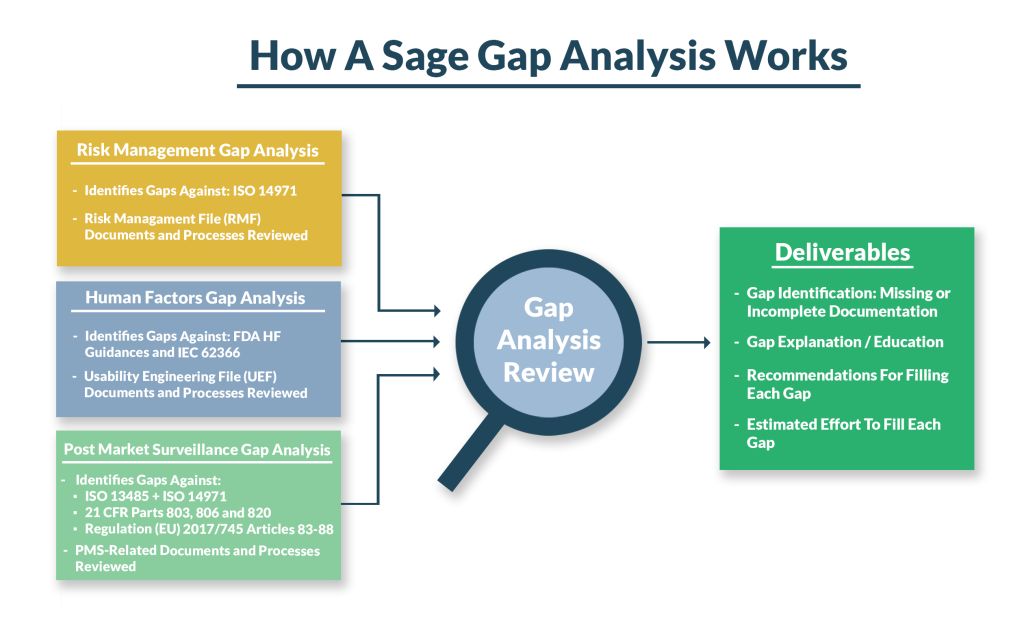
Submission uncertainty can be replaced with confidence when objective evidence rather than familiarity is used as an evaluation tool. At Sage Research + Design, our Usability Engineering (HF) File and Risk Management File Gap Analyses are designed to provide exactly that objective evidence.

The strongest submissions are not those containing the greatest volume of documentation; they are the ones in which risk management, human factors usability engineering, design controls, and supporting evidence tell one consistent story.
Foreseeable hazards are comprehensively documented and analyzed in the risk management process. Risk controls are implemented in the design and labelling and evaluated through usability testing and other verification and validation activities. Traceability is tight and easily understood. Residual risks are communicated appropriately and a conclusion of acceptable residual risk is obvious and justifiable. Collectively, the submission demonstrates a systematic approach to managing patient and user safety.
Sage’s gap analysis activities provide an opportunity to evaluate your documentation and processes against current regulatory expectations and strengthen your submission before it reaches a regulatory reviewer. While Sage can perform Usability Engineering and Risk Management File gap analyses as separate services, they are maximally beneficial when combined to support a consistent and defensible regulatory narrative.
Where appropriate, we can also conduct mock regulatory reviews, and mock ISO-14971, ISO-13485, and Post-Market Surveillance & Vigilance audits that help teams anticipate the questions reviewers are most likely to ask.
Every medical product company strives to develop safe, effective products supported by robust documentation. When preparing for submission, the primary question is whether an experienced reviewer, approaching your submission for the first time, would reach the same conclusion. Answering that question with a gap analysis before your submission is one of the most effective ways to reduce regulatory risk, strengthen internal confidence, and improve the likelihood of a smooth review.
Contact Sage to Discuss How Gap Analyses Can Boost Your Confidence
If your team is preparing for a regulatory submission, or simply wants greater confidence that your risk management and human factors documentation and processes reflect current best practice, Sage can provide a comprehensive gap assessment and provide the independent perspective you need to move from believing you are ready to knowing you are.
Want more? Ask us about our Post-Market Surveillance Gap Analysis!
Our PMS gap analysis identifies gaps in conformance to applicable PMS standards, including:
- ISO 13485:2016
- ISO 14971:2019
- 21 CFR Part 803
- 21 CFR Part 806
- 21 CFR Part 820
- Regulation (EU) 2017/745 Articles 83-88

About the Author
Natalie Stepien-Bernabe, PhD is a senior Human Factors/User Experience Consultant at Sage Research + Design. She and her colleagues at Sage are experienced helping a wide variety of product teams incorporate human factors processes and successfully prepare for their FDA or international submissions. The human factors team follows the FDA Guidance and IEC 62366-1/62366-2 and is skilled at conducting and documenting Use-Related Risk Analyses, analyses of users, uses and use environments, heuristic evaluations/expert reviews, formative and validation usability testing and many other HF activities. We are ready to help with medical devices, drug/biologic products, or combination products.
Sage Research + Design provides HF Process & Design Assessments, Start-to-Finish HF Services (full package or ala carte), FDA Submission Readiness Evaluations and Human Factors Training. Best of all their small nimble team is flexible, fun to work with, and will quickly demonstrate that they truly care about you and getting your MedTech product through the HF submission process! Contact us to learn more.